
Tensing Up

Maintaining consistent and appropriate verb tenses in a book prevents confusion related to past, present, and future events. A book’s main narrative verb sense stays the same throughout. However, verb tenses vary in spoken dialogue, inner dialogue, memories, and flashbacks. Verb forms are also based on whether the person/thing performing the action (subject) is singular or plural, but for this article, I won’t be addressing that aspect.

English nonfiction books tend to be written in present tense, but not all. Nonfiction books focused on historical events—for example, memoirs and biographies—are written in past tense. Poetry can be written in any verb tense, based on the perspective of the poet.

English fiction novels are typically written in past tense, but not always. For example, young adult fiction books are sometimes written in present tense because it’s more engaging and creates an increased sense of involvement.

Did you know that English has twelve main verb tenses? Along with basic past, present, and future tenses, we all use variations of the basics on a daily basis, despite most of us not being able to name them. If you’ve ever studied a foreign language, then you know that mastering any language involves learning the proper verb forms.

Following is a list of the twelve verb tenses, along with two short examples for each. The relevant verbs are in bold print.

  • present simple
    • I want to go home.
    • She wants to go home.
  • present continuous
    • I am helping my friend.
    • They are helping each other.
  • present perfect
    • I have tried Japanese food.
    • He has never tried sushi before.
  • present perfect continuous
    • I have been waiting forever.
    • She has not been waiting long.
  • past simple
    • I started the car.
    • You started the meeting.
  • past continuous
    • I was looking away when he walked by.
    • We were looking at the screen when it turned off.
  • past perfect
    • I had finished my meal when she called.
    • They had finished the job by the time the owner arrived.
  • past perfect continuous
    • I had been wondering where you were when you texted.
    • He had been wondering what to do when you left.
  • future simple
    • I will walk to work today.
    • She will walk to the store later.
  • future continuous
    • I will be visiting a friend next week.
    • He will be visiting his parents on Thanksgiving.
  • future perfect
    • By Friday, I will have used all of my crafting paint.
    • They will have used most of their mobile date before the end of the month.
  • future perfect continuous
    • I will have been driving for hours by the time I reach the hotel.
    • She will have been driving the new truck by then.

Other verb forms often considered separate tenses:

  • future in the past
    • I thought I would finish the project by Saturday.
  • conditional
    • He could sing if he wanted to.
  • imperative
    • Stop the bus!”
  • subjunctive
    • She insisted that he leave.

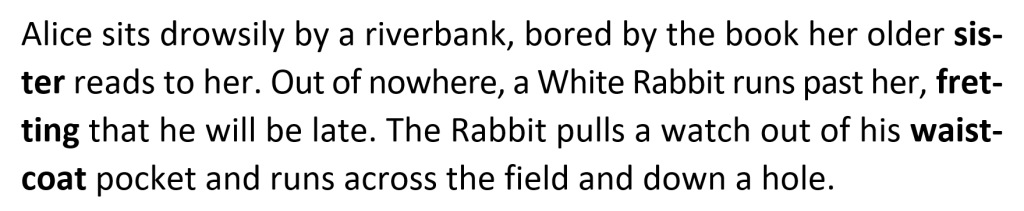
Below is an excerpt from the story “The Adventure of the Speckled Band,” published in Adventures of Sherlock Holmes by Sir Arthur Conan Doyle (1892). Tenses for six highlighted verbs have been changed to demonstrate how using the wrong verb tense alters the meaning of a passage and can confuse the reader. See if you can determine what the appropriate verb tense should be in each case. Then keep reading to see the original text with the correct verb tenses reinserted.

(incorrect verbs highlighted)

Sherlock Holmes ran her over with one of his quick, all-comprehensive glances. “You must not fear,” said he, soothingly, bending forward and patted her forearm. “We are setting matters right, I have no doubt. You have come in by train this morning, I see.”

“You know me, then?”

“No, but I observe the second half of a return ticket in the palm of your left glove. You must have started early, and yet you will have had a good drive in a dog-cart, along heavy roads, before you reached the station.”

The lady gave a violent start, and stared in bewilderment at my companion.

“There is no mystery, my dear madam,” said he, smiling. “The left arm of your jacket was spattered with mud in no less than seven places. The marks are perfectly fresh. There is no vehicle save a dog-cart which throws up mud in that way, and then only when you sit on the left-hand side of the driver.”

“Whatever your reasons may be, you would be perfectly correct,” said she. “I started from home before six, reached Leatherhead at twenty past, and came in by the first train to Waterloo. Sir, I could stand this strain no longer; I shall go mad if it continues. I have no one to turn to—none, save only one, who cares for me, and he, poor fellow, can be of little aid. I have heard of you, Mr. Holmes; I have heard of you from Mrs. Farintosh, whom you had been helping in the hour of her sore need. It was from her that I had your address. Oh, sir, do you not think that you could help me, too, and at least throw a little light through the dense darkness which surrounds me? At present it is out of my power to reward you for your services, but in a month or six weeks I shall be married, with the control of my own income, and then at least you shall not find me ungrateful.”

Holmes turned to his desk, and unlocking it, draws out a small case-book, which he consulted.

Here is the original text with the correct verbs. Explanatory notes are included below each affected paragraph.

Sherlock Holmes ran her over with one of his quick, all-comprehensive glances. “You must not fear,” said he, soothingly, bending forward and patting her forearm. “We shall soon set matters right, I have no doubt. You have come in by train this morning, I see.”

Incorrect: are setting – present continuous
Correct: shall set – future simple
“Are setting” infers that the action had already begun.
“Shall set” correctly indicates that their action will happen in the future.

“You know me, then?”

“No, but I observe the second half of a return ticket in the palm of your left glove. You must have started early, and yet you had a good drive in a dog-cart, along heavy roads, before you reached the station.”

Incorrect: will have had - future perfect
Correct: had - past simple
“Will have had” infers that her drive will be completed by a certain time in the future.
“Had” correctly indicates that her drive happened in the past.

The lady gave a violent start, and stared in bewilderment at my companion.

“There is no mystery, my dear madam,” said he, smiling. “The left arm of your jacket is spattered with mud in no less than seven places. The marks are perfectly fresh. There is no vehicle save a dog-cart which throws up mud in that way, and then only when you sit on the left-hand side of the driver.”

Incorrect: was – past simple
Correct: is – present simple
Using “was” here refers to the action of spattering mud, which he did not witness.
Using “is” here correctly indicates that he currently sees spattered mud on her jacket.

“Whatever your reasons may be, you are perfectly correct,” said she. “I started from home before six, reached Leatherhead at twenty past, and came in by the first train to Waterloo. Sir, I can stand this strain no longer; I shall go mad if it continues. I have no one to turn to—none, save only one, who cares for me, and he, poor fellow, can be of little aid. I have heard of you, Mr. Holmes; I have heard of you from Mrs. Farintosh, whom you helped in the hour of her sore need. It was from her that I had your address. Oh, sir, do you not think that you could help me, too, and at least throw a little light through the dense darkness which surrounds me? At present it is out of my power to reward you for your services, but in a month or six weeks I shall be married, with the control of my own income, and then at least you shall not find me ungrateful.”

Incorrect: would be – conditional
Correct: are – present simple
“Would be” infers that the accuracy of his conclusion is conditional based on something else. Yet, she does not specify a condition.
“Are” correctly indicates that his conclusion is currently definitely correct, regardless of which reason he associated with his conclusion.

Incorrect: had been helping – past perfect continuous
Correct: helped – past simple
“Had been helping” infers that he helped Mrs. Farintosh in the past and continued to over a period of time.
“Helped” correctly indicates that he helped the woman in the past at a specific time.

Holmes turned to his desk, and unlocking it, drew out a small case-book, which he consulted.

Incorrect: draws – present simple
Correct: drew – past simple
If the narrative tense throughout the book were present tense, then “draws” would be fine. But the narrative tense throughout the book is past tense, so “drew” is correct, and indicates that he performed the action in the immediate past.

When editing, if I ever really get stuck on a verb that is clearly wrong that I’m not sure about, first I ask the client what their intentional meaning is, then I consult Perplexity AI to confirm the correct tense/form. It’s very helpful with solving complicated grammar issues.


Text Copyright © 2025 Karolyn Herrera
Drawing Lines

HYPHENS and DASHES are the most misused punctuation marks in the English language after commas, in my experience. Have you ever noticed that some writers refuse to use them, while others sprinkle them willy-nilly throughout their work without any apparent logic or reason? Many confuse hyphens with dashes, or think they are interchangeable. In fact, hyphens are not dashes and they each have specific uses.

Let’s get into it.

Why do we insert these horizontal little lines in our writing in the first place? Essentially, their purpose is to clarify phrases or sentences that would likely be misunderstood without them. If you compare the pairs of examples below, you will see how the meaning of a sentence can be changed depending on if or how hyphens or dashes are used.

The Hendersons brought their three-year-old sons to the doctor’s office. (hyphens)
(twins who are 3 years old)
The Hendersons brought their three year-old sons to the doctor’s office. (hyphen)
(triplets who are 1 year old)
My great-aunt, as well as Aunt Lucy, came to the family reunion. (hyphen)
(father/mother’s aunt plus father/mother’s sister Lucy)
My great aunt, as well as Aunt Lucy, came to the family reunion. (no hyphen)
(father/mother’s wonderful sister plus father/mother’s sister Lucy who might not be wonderful)
Small-business owners in the construction industry are often discriminated against. (hyphen)
(owners of small businesses)
Small business owners in the construction industry are often discriminated against. (no hyphen)
(business owners who are short or petite)
Her husband will discuss the check—in process as we speak—with the hotel manager. (em dashes)
(Her husband is discussing the check at this moment with the hotel manager as planned.)
Her husband will discuss the check-in process as we speak with the hotel manager. (hyphen)
(Her husband plans to discuss the process for checking into the hotel while some other individuals speak with the hotel manager.)
He attempted to re-collect his scattered thoughts. (hyphen)
(become calm and rational again)
He attempted to recollect his scattered thoughts. (no hyphen)
(remember fading thoughts)
I prefer the Monday-Friday schedule. (hyphen)
(Mondays and Fridays only)
I prefer the Monday – Friday schedule. (en dash)
(Monday through Friday)

In handwritten text, hyphens and dashes are mainly identifiable by how they are used, not by size, because of the wide variation in people’s handwriting styles. But in printed text, length matters, as well as how each one is used within the text.

Below, the hyphen and dashes are shown in order of width along with ways to insert them in your text.

Hyphen
* Use the hyphen key to the right of the number zero on the numbers row.
En Dash
* Type a word/number, type a space, type the hyphen key, type a space, type another word/number, type a space (AutoFormat inserts the en dash in Word).
* Enable Num Lock, use shortcut key combination: Ctrl plus the minus key on the numeric keypad.
* Insert > Symbol > More Symbols > Special Characters > select En Dash > Insert > Close
Em Dash
* Type a word, type two hyphens, type another word, type a space (AutoFormat changes the hyphens into an Em Dash)
* Enable Num Lock, use shortcut key combination: Ctrl plus Alt plus the minus key on the numeric keypad.
* Insert > Symbol > More Symbols > Special Characters > select Em Dash > Insert > Close
When to use a hyphen

Connecting two or more words and numbers to form one idea

absent-minded professorfull-length movie
fast-moving vehicleowner-operator of a business
six-hour drivethirty-four-year-old man
She spoke matter-of-factly about her trauma.ice-cream sandwich
over-the-counter medicinecase-by-case approach

Connecting last names of spouses (double surname)

Sarah Bennett-Johnson waved at me from across the street.
I invited Mr. and Mrs. Mendoza-Harris to the dinner party.

Connecting the ten’s place and one’s place in numbers from 21 to 99 when written as words

sixty-fiveninety-seven

Writing telephone numbers, account numbers, serial numbers, part numbers, model numbers, etc.

Call 1-800-867-5309
Product serial number: A123-B456-C789-D012

Dividing words that start at the end of one line and end at the beginning of the next line (Typically, words are not hyphenated at the end of three consecutive lines; these are hyphenated for demonstration purposes only.)

Portion of book text displaying 3 hyphenated words appearing at the end of separate lines

Signifying a missing or inferred part of a hyphenated word (suspended/hanging hyphen); *I typically try to avoid these by rewording the sentence or including two complete hyphenated words.

Fifteen- and twenty-year contracts are subject to lower fees.
She selected the highest- and next-highest-scoring groups for the final round.
The study included English- and Spanish-speaking participants.

Adding prefixes (check a dictionary if you’re not sure whether a hyphen is needed)

ex-husbandex-neighbor
extraexample
self-confidenceself-employed
selfishnessselfsame
mid-eightiesmid-Atlantic states
midnightmidsection
all-knowing oracleall-encompassing solution
They gave their all, knowing the finish line was near.allowed
re-sent (sent again)re-sign (sign again)
resent (begrudge)resign (give up, quit)
registerrespond

Creating fractions with compound adjectives

Add two-thirds of a cup of sugar.
The prize of a half-million dollars is up for grabs.

Representing the minus sign when writing negative numbers and subtracting

204=16 (AutoFormat will change the hyphen to an en dash when spaces are added, though)
5 degrees Fahrenheit
When NOT to use a hyphen (or dash)

When the modifier/adjective comes after the noun

Her students were well informed about the rules.
The house was poorly lit.

When combining an adverb with an adjective or participle

greatly anticipated event
very helpful instructions
horribly executed strategy

For open and closed compound words

Chocolate ice cream is my favorite dessert.(noun; open)
White House staff roles have been restructured.(adjective, open)
She offered to proofread my manuscript.(verb, closed)
The cover of my notebook was covered with stickers.(noun, closed)
When to use an EN dash (width of an N)

Connecting numbers or words to indicate a range, score, time period, or distance not introduced with the word “from”; replaces the word “to” or “through” (AutoFormat adds a space before and after, but they are not necessary)

These books are for children ages 5 – 8.
The Bandits won the game with a score of 10 – 9.
The Age of Enlightenment was approximately 1685–1815.
This company’s work week is Monday – Saturday.

For clarity when compound adjectives include an open compound word

Roaring Twenties–style fashion was all the rage. (no spaces around en dash)
Teachers provided some high school–level reading material. (no spaces around en dash)
When to use an EM dash (width of an M)

Before and after parenthetical and explanatory expressions

John packed all his camping supplies—tent, stove, food, dishes, and chairs—in the trunk.
The United Kingdom—England, Scotland, Wales, and Northern Ireland—is a constitutional monarchy and parliamentary democracy.

After a list that comes at the beginning of a sentence

Guitar, ukulele, banjo—I want to learn how to play all of them!

Indicating an interruption or change in thought (informal writing)

My order was for a BLT—not a turkey club sandwich.
He’s running to the corner with—what is he doing now?

Indicating interrupted dialogue

Dorothy rambled on. “I just don’t understand why—”
“Please stop!” exclaimed Jen, exasperated.
“He should be here any—”
“Oh good,” Luke said, interrupting, “he just arrived.”

I’ve tried to be as comprehensive as possible. If you’re ever unsure whether a word or phrase should be hyphenated, check a dictionary or grammar book. If you feel this post is missing any important hyphen/dash rules or examples, please let me know in the comments.

There Are Dummies

there


[Yes, the article title is an example of what not to do] 

Starting sentences with “There is/are” or “There was/were” is rarely recommended and usually unnecessary. The same applies to beginning sentences with “It is/was.” Undefined or unintroduced subjects are called dummy subjects.

Beginning a sentence in this way amounts to stating that a thing or things exist(s), then proceeding to say what you want to say about those things. It’s unnecessary to state that something exists because once you describe the thought or action involving this thing, you are already automatically stating that it exists (Yes, that sentence was painful to write…). Doing this twice in a sentence is not only redundant but shifts the focus from the main thought or idea to the establishment of the existence of whatever the subject of the sentence is.

Compare these examples:

Wrong: There was a duplicate keypad on the far wall of the foyer, and I quickly crossed to enter the same code.

Correct: I quickly crossed to the duplicate keypad on the far wall of the foyer and entered the same code.

In the original sentence, the subject appears to be the keypad instead of the character in the story. In the rewritten sentence, the focus is now on the character’s actions. 

Another set of examples:

Wrong: There were faint sounds of tires in the driveway that caused her pulse to race in anticipation.

Correct: The faint sound of tires in the driveway tickled her ears, and her pulse raced in anticipation.

The original sentence is awkward. The rewritten sentence allows the reader to put themselves in the character’s shoes and is much more interesting.

Writers should avoid dummy subjects because they weaken their writing, making it vague and indistinct. In the examples above, “There” replaced the subjects of the sentences. However, that was unnecessary because we know what the subjects are. If you know what the subject is, then the subject shouldn’t be replaced.

Grammar refresher:

  • Subject: performs the action in a sentence – always a noun (person, place, thing) or a pronoun (replaces a noun: he, she, it, they, that, I)
  • Object: receives the action in a sentence
  • Verb: the action performed or received

The only acceptable exceptions would include sentences in which the subject is unknown, or dialogue that involves answering a question or giving directions. For example, if the purpose of the sentence is to state that something or someone is doing something, but you don’t know who or what is actually performing the action, then it would make sense to start with, “There is/are” or “There was/were.”

Reviewing your work and rewording sentences that begin with unnecessary dummy subjects is one of many ways to liven up and strengthen your writing. I find the need to do this with my own writing on a regular basis.

Let me know what you think in the comments!