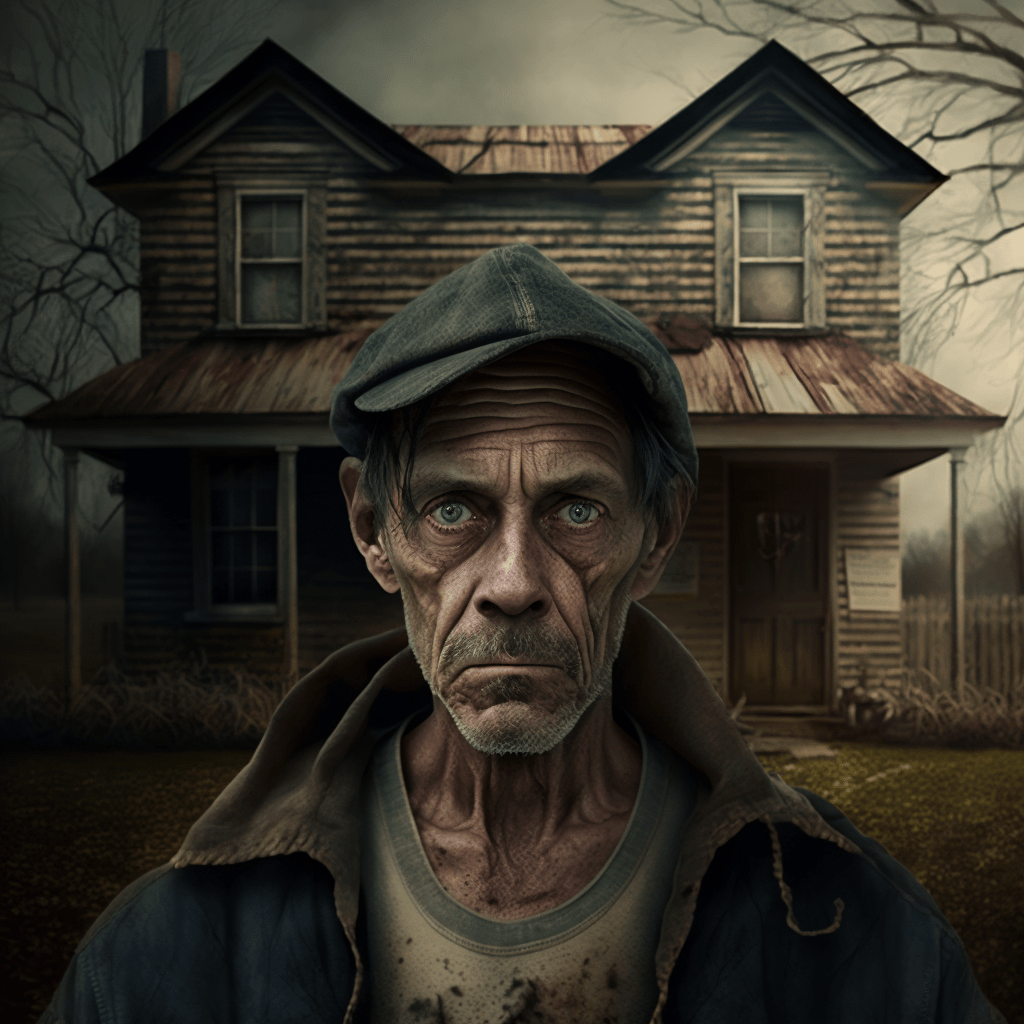
There was a poor man from Kentucky
Who lived a life oh so unlucky.
A sinkhole swallowed his house
His new truck was wrecked by cows
And his wife left him for boss Chucky.
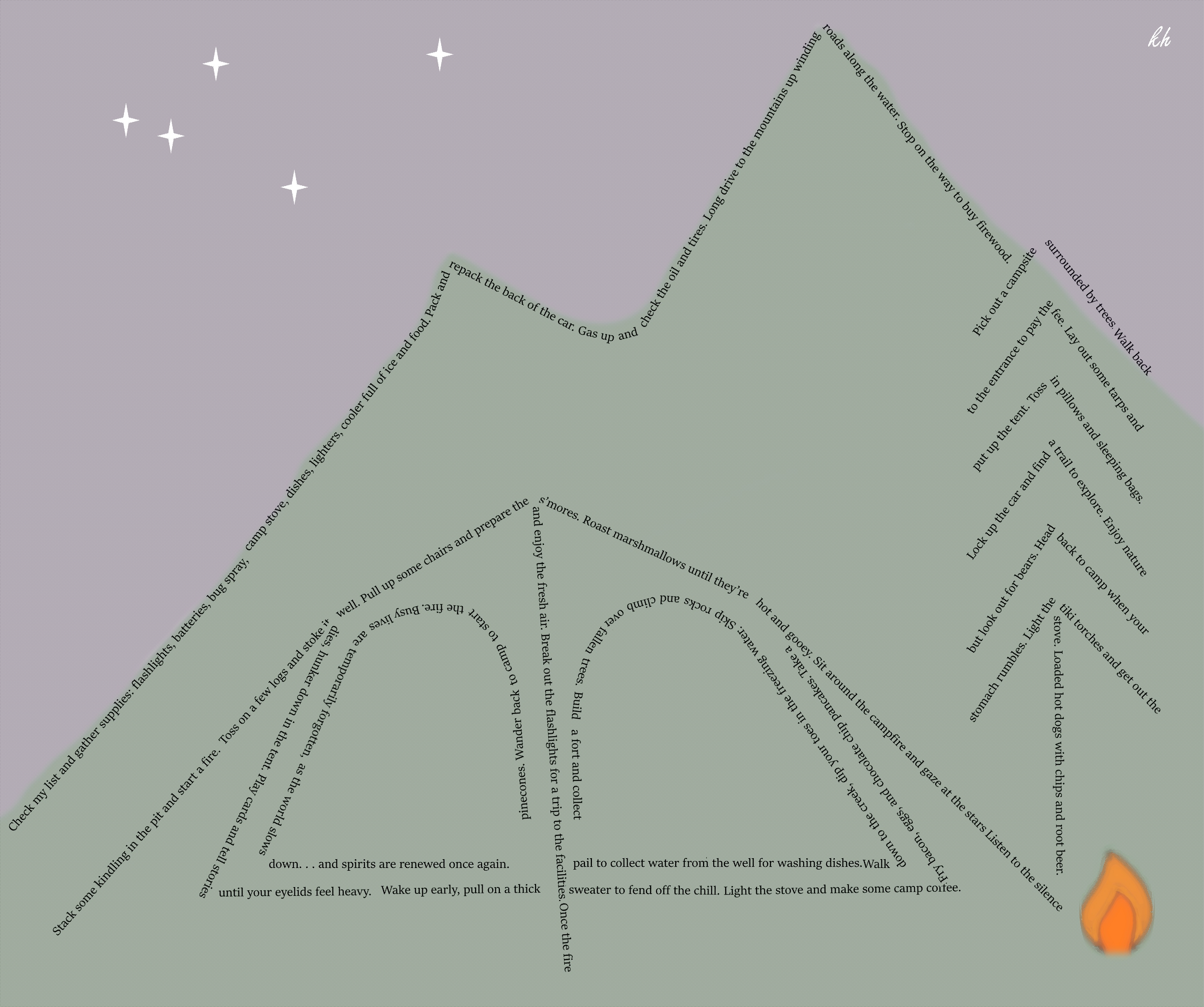
This poem is about one of my favorite activities. It’s expressed in the “concrete poetry” style.
In case you don’t feel like standing on your head to read all of the text in the image, I’ve also included the poem in standard (boring?) paragraph form below the image as well as a link to the full-size image since it looks strange on WordPress when viewed on a small screen.
If you succeed in creating your own concrete poem, please please share a link to it in the comments below. I’m amazed at some of the examples I’ve found online. So inspiring!
Check my list and gather supplies:
flashlights, batteries, bug spray,
camp stove, dishes, lighters,
cooler full of ice and food.

Pack and repack the back of the car.
Gas up and check the oil and tires.
Long drive to the mountains
up winding roads along the water.
Stop on the way to buy firewood.

Pick out a campsite surrounded by trees.
Walk back to the entrance to pay the fee.
Lay out some tarps and put up the tent.
Toss in pillows and sleeping bags.

Lock up the car and find a trail to explore.
Enjoy nature but look out for bears.
Head back to camp when your stomach rumbles.
Light the tiki torches and get out the stove.

Loaded hot dogs with chips and root beer.
Stack some kindling in the pit and start a fire.
Toss on a few logs and stoke it well.
Pull up some chairs and prepare the s’mores.
Roast marshmallows until they’re hot and gooey.

Sit around the campfire and gaze at the stars.
Listen to the silence and enjoy the fresh air.
Break out the flashlights for a trip to the facilities.
Once the fire dies, hunker down in the tent.
Play cards and tell stories  until your eyelids feel heavy.

Wake up early, pull on a thick sweater to fend off the chill.
Light the stove and make some camp coffee.
Fry bacon, eggs, and chocolate chip pancakes.
Take a pail to collect water from the well for washing dishes.

Walk down to the creek,
dip your toes in the freezing water.
Skip rocks and climb over fallen trees.
Build a fort and collect pinecones.
Wander back to camp to start the fire.

Busy lives are temporarily forgotten,
as the world slows down...
and spirits are renewed once again.
What makes a poem different from a story? A story is written in paragraphs, consisting of (mostly) full sentences and some dialogue. Poetry is written in a variety of styles.
Some styles use full sentences, but often poetry consists of sentence fragments and phrases that are grouped together in stanzas*. Poetry can be used to tell a story, or simply to describe a feeling. Sometimes poems are cryptic, requiring analyzation to determine their true meaning. Poetry can be humorous or intentionally somber. Rhyming patterns* vary and are not always consistent. Meter*, alliteration*, and repetition are frequently just as important as the rhyming pattern. Some poems are very short, only a few lines long. A few famous poems are long enough to fill a large, thick book. Occasionally, poets may play with formatting to display their work creatively on the page.
When I write poetry, I typically write free verse with occasional rhyming. A few of them are formatted on the page to match the theme of the poem just for fun. I love reading poems that tell a story in a unique way, as well as compelling free verse.
Can you match the twenty kinds of poetry listed below to their descriptions? I must admit that I was previously unfamiliar with a couple of them, such as the villanelle (…??). Click on the link at the end of the article to check your answers.
Do you know of any other type of poetry not mentioned here? Let me know in the comments and share which kind of poetry is your favorite to read and which is your favorite to write. Common poetry terms (noted with an *) are defined after the poem descriptions.
Types of poetry (in alphabetical order):
Acrostic
Ballad
Blackout poetry
Concrete poetry
Ekphrastic poetry
Elegy
Epic
Epigram
Epitaph
Free verse
Haiku
Limerick
List poetry
Lyric poetry
Narrative poetry
Ode
Palindrome* poetry
Pantoum
Sonnet
Villanelle
Descriptions (in random order):
Japanese poetry consisting of three lines; may or may not rhyme:
Line 1: five syllables
Line 2: seven syllables
Line 3: five syllables
Fourteen lines; typically about love, romance, or desire; rhyme schemes*:
ABBA ABBA CDE CDE or
ABAB CDCD EFEF GG
Nineteen lines; ABA ABA ABA ABA ABA ABAA rhyme scheme; certain lines are repeated:
Line 1
Line 2
Line 3 –
Line 4
Line 5
Line 6 – repeat line 1 –
Line 7
Line 8
Line 9 – repeat line 3 –
Line 10
Line 11
Line 12 – repeat line 1 –
Line 13
Line 14
Line 15 – repeat line 3 –
Line 16
Line 17
Line 18 – repeat line 1
Line 19 – repeat line 3
First letter of each line vertically spells out a name, word, or phrase
Poem with no rules
Usually short; written to praise a person, thing, or event; often ten lines
Funny or shocking; AABBA rhyme scheme; lines 3 and 4 are shorter than the other lines; the last line is the punchline.
Written in mourning after a death; often consisting of several two-line stanzas
Tells a dramatic or emotional story; ABAB or ABCB rhyme scheme
Vividly describes a painting, sculpture, drawing, or other form of visual art
Designed to take a particular shape or form on the page; spacing or layout is often manipulated to emphasize a theme or element in the text, or sometimes make the physical shape of the poem’s subject
Short, witty, and satirical
Short phrase written in memory of a person whose died, often inscribed on a tombstone or grave marker.
Expressive, songlike poem that is centered on emotions and focused on the poet’s state of mind and personal themes rather than narrative arcn emotions
Large portions of an existing text are blacked out to reveal the remaining visible words that form the new poem
Very long poem which tells a story about a character’s adventures, accomplishments, and daring feats.
Shorter yet fully developed story that focuses more on plot instead of emotion or adventure, often with a specific rhyming scheme.
Poem that consists of four-line stanzas* that repeat in a pattern; no set length; changes in punctuation, verb tense, pronouns, word order, homonyms, and plurality are allowed when repeating lines.
Line 1
Line 2
Line 3
Line 4 –
Line 5 – repeat line 2
Line 6
Line 7 – repeat line 4
Line 8 –
Line 9 – repeat line 6
Line 10
Line 11 – repeat line 8
Line 12 –
Line 13 – repeat line 10
Line 14
Line 15 – repeat line 12
Line 16 – Final stanza continues same pattern but ends with a repeat of line 1 as the final line in the poem.
Poem that reads the same forward or backward with a word in the center as the reversal point
List of things; funny or moving last line
Visit https://karolyneditsbooks.com/poetry_types.html to check your answers. [I will add any new poetry types at the link above, but you won’t find them in this blog post because I want to keep the post title and poetry exercise intact.]
Alliteration – Repetition of the same sound at the beginning of a series of words in succession
Meter – Pattern of stressed syllables (long-sounding) and unstressed syllables (short-sounding) in poetry
Palindrome – Word, phrase, verse, sentence, or poem that reads the same forward or backward
Rhyme scheme/pattern – Lines that end with rhyming words are identified by the same letter. Examples of rhyme schemes:
AA BB CC
three stanzas
last words of lines 1 and 2 rhyme
last words of lines 3 and 4 rhyme
last words of lines 5 and 6 rhyme
AABBA
in each stanza, last words of lines 1, 2, and 5 rhyme
in each stanza, last words of lines 3 and 4 rhyme
Stanza – Set amount of lines grouped together in poetry by their length, meter, or rhyme scheme
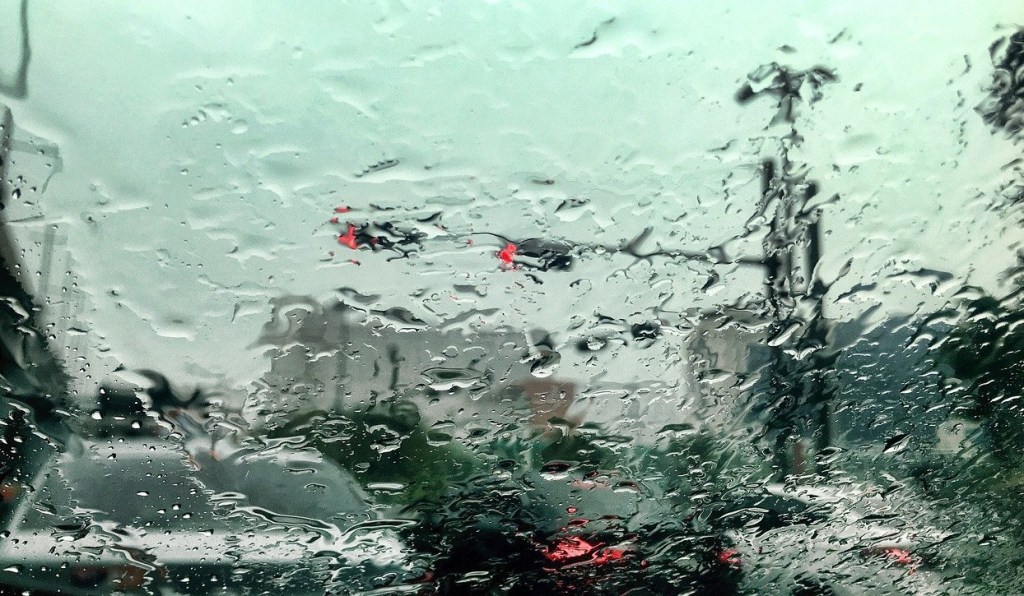
Vague language leaves readers with too many questions, unsure about what the author is describing or explaining. Imprecise language also tends to be bland compared to a well-written narrative. Precise yet vivid language creates a clearer picture of the scene in readers’ minds. The difference between the two can be compared to the difference between looking through a wet, dirty textured glass window and looking through a dry, clean plate glass window. Brevity may often be lauded as the “soul of wit,” but only if the writer hasn’t sacrificed clarity and imagination in the process.
Read through your manuscript out loud and try to put yourself in the mind of a fresh reader who doesn’t have any background information, doesn’t know what’s going to happen later, and is reading it for the first time. When you refer to a character or location, will your reader know who or where you’re talking about? Will they have to reread a few pages to find out? Will they just have to remain in the dark and hopefully make the connection later?
Below are six examples of both fiction and nonfiction narrative that is vague or confusing. Possible questions the author might address to clarify the content are listed next. Following the questions for each example, the content is rewritten in more specific and expressive language.
She reached down to grab a pot and fill it with water.
Questions the author might address: Was the pot on the floor or in the cupboard? What type of pot was it? How big was it? Did she fill it from the faucet or a water bottle?
Rewritten: She bent down to pull open the cupboard door and reached in to grasp the handle of a medium-sized pot. She carried it to the sink and twisted the faucet handle to run the cold water.
I saw the kitten go up to my new boss and lick him. Nick took him to the kitchen.
Questions the author might address: How did the kitten go up to Nick (new boss)? How did Nick react? What else did Nick do?
Rewritten: Out of the corner of my eye, I barely caught a glimpse of the tiny black shadow that streaked across the floor to slide comically into a heap in front of my new employer. Nick’s face lit up and he bent down to scoop up the kitten, who was now purring furiously and trying to lick any part of his human that he could reach. Chuckling, Nick carried him into the kitchen, setting his laptop case down on a chair, and a few pieces of mail on the dining table.
After pressing the numbers, I heard the lock click, then went inside. I entered the wrong code, then did it right, and disabled the alarm.
Questions the author might address: How many numbers were in the code? Did she enter the code inside or outside or both? How much time did she have to enter it correctly? How did she know the code was wrong? How did she react?
Rewritten: After pressing each of the six numbers carefully, I heard the lock click, then grasped the curved handle. I pushed the door open then closed it behind me. A duplicate keypad was on the far wall of the foyer, and I crossed quickly to enter the same code within ninety seconds to disarm the alarm. After screwing it up the first time, the keypad flashed red accusingly at me. Anticipating the blaring alarm, ready to cover my ears, I cursed and entered the code correctly.
When I read the scene that takes place at the ball, I picture the ballroom, dancers, and musicians in my mind. Everything is beautiful and I wish I was there.
Questions the book reviewer might address: What does this ballroom look like? How can this beautiful scene be described in more detail? How does it make the reviewer feel? Why should readers care?
Rewritten: When I read the scene that takes place at the ball, it transports me to a fanciful ballroom, where I find myself gliding effortlessly around to a waltz, in the arms of a debonair, masterful dancer. The décor is fabulous and twinkly, and the ladies’ gowns are voluminous and dreamy. The musicians are flawless, and the sonatas and concertos surround us. Time is suspended, and cares float away.
Unsurprisingly, the discovery of this diagnosis allowed physicians to label women as unfit to handle stress—an argument to limit their exposure to work or education.
Questions the author might address: Did the doctors say that women were unable to handle any amount of stress? What type of diagnosis is being discussed? Was the argument actually used in this way or was it only intended to be used in this way?
Rewritten: Unsurprisingly, the discovery of this new, universal diagnosis allowed physicians to label women as unfit to handle excessive stress—an argument exploited to limit their exposure to work or education.
Today, twenty-seven percent of all funding for energy R&D is spent on nuclear energy.
Questions the author might address: Was the funding by the US, a group of countries, or worldwide? Was it federal or private funding? What timeframe is the statistic from?
Rewritten: In 2016, twenty-seven percent of U.S. federal funding for energy R&D was spent on nuclear energy.
 Write to Reason